
What sound solutions are available for a padel location?
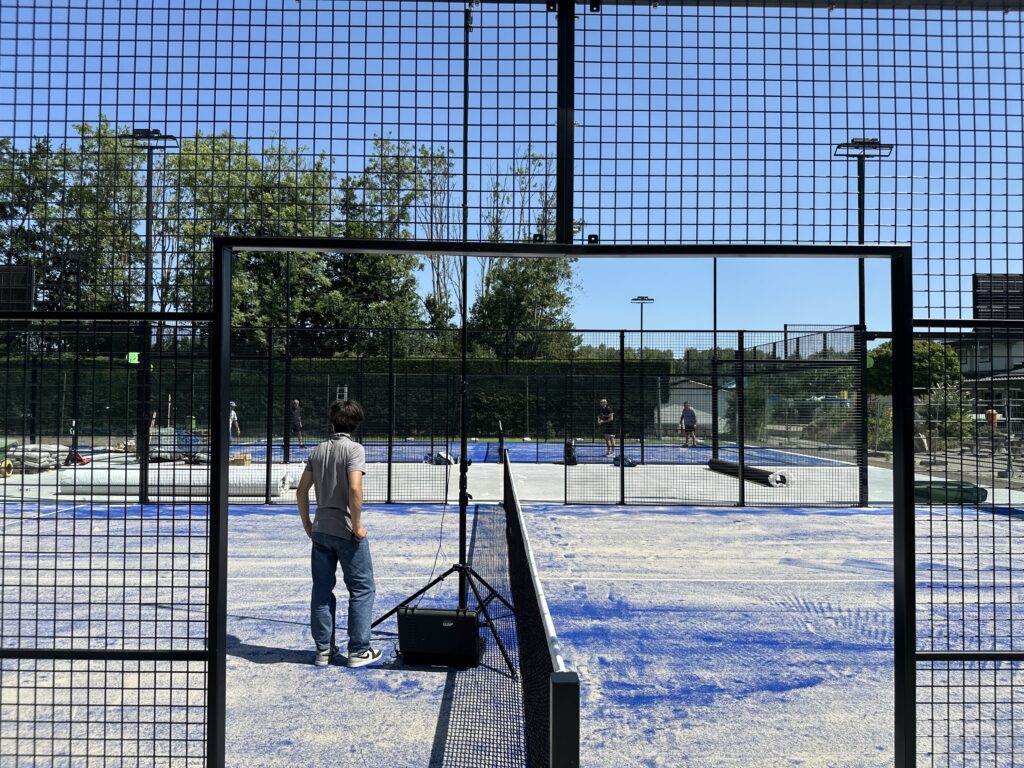
Noise pollution is one of the biggest obstacles when developing a padel location. Municipalities are imposing increasingly strict requirements, local residents are more likely to complain, and an acoustic study is almost always mandatory for outdoor courts. Fortunately, there are proven solutions that can help you comply with noise standards and create support among both the municipality and the local community. In this article, we answer the most frequently asked questions about noise pollution at padel courts and the available solutions. Why does a padel court cause so much noise pollution? A padel court produces more noise than a tennis court because the cage structure acts as a sound box. Hitting the ball against glass and steel reflects the sound in all directions. The average sound power level of a padel court is around 91 dB, which is approximately 10 dB more than tennis. There are two main sources of noise in padel. The first is the source noise generated when the racket hits the ball. The second, and larger, source is the impact noise of the ball against the glass and mesh of the cage structure. The glass walls reflect the sound instead of absorbing it, and the steel structure amplifies this effect. The closer the court is to residential properties, the greater the chance of complaints and mandatory measures imposed by the municipality. What sound solutions are available for a padel court? There are two main solutions for noise pollution at a padel court: sound-absorbing panels that are attached directly to the cage structure and freestanding noise barriers that are placed next to or around the court. In many situations, a combination of both is the most effective. Sound-absorbing panels Panels are installed on the outside of the mesh of the cage structure. They absorb the sound at the source instead of reflecting it. The court remains visually open and the dynamics of play do not change. Panels can be applied on one side, on multiple sides, or only in the lower or upper sections of the cage. They can also be installed afterwards on existing courts. Noise barriers A noise barrier is a freestanding structure placed next to or around the padel court. A noise barrier works over a greater distance and shields the noise in the direction of residential properties. Barriers can be up to 6 to 8 metres high and tens of metres long. They can also be constructed using coconut fibre or green fabric, on which climbing plants can grow. This creates a more natural appearance and increases the likelihood of acceptance by the municipality and local residents. Combination of panels and barrier In practice, a combination of sound-absorbing panels and a noise barrier is often the most effective approach. Because of the panels, the noise barrier can sometimes be lower, which saves costs and makes the permit process easier. Read more about sound solutions How do sound-absorbing panels work at a padel court? Sound-absorbing panels are attached to the outside of the mesh of the cage structure. They absorb the sound that would otherwise be reflected by glass and steel. Independently tested in an acoustic laboratory, they achieve sound absorption class A, with an absorption value of 0.80 and a sound insulation index of 19 dB. In practice, this results in a clearly audible reduction in noise at distances of approximately 40 to 100 metres. The panels can be used flexibly: on one side of the court facing residential properties, on multiple sides, or in the lower and/or upper sections of the cage. They can also be combined with glass walls or other noise-control measures. An important point to take into account: as soon as panels reduce the wind permeability of the cage structure, the wind load on the structure increases. The steel structure must then be structurally reinforced in accordance with the applicable wind zone. This means heavier posts, additional columns or modified connections. This is not an optional step, but a safety requirement. When are sound-absorbing panels mandatory at a padel location? Sound-absorbing panels are not automatically mandatory, but in practice they are often necessary when a padel court is located near residential properties and an acoustic study shows that the noise standards are being exceeded. The municipality determines this based on the acoustic report submitted with the permit application. For outdoor courts, an acoustic study is almost always mandatory if the location is near residential buildings. If the study shows that the noise standards are being exceeded, the municipality imposes conditions on the permit. Sound-absorbing panels may then be a measure required by the municipality, or one that you proactively implement to comply with the standards. In some cases, a noise barrier is sufficient; in other cases, panels are necessary; and sometimes a combination of both is the only workable solution. Which measure is required always depends on the specific location and the outcome of the acoustic study. What is the difference between an indoor and outdoor court in terms of noise? An indoor court produces just as much noise as an outdoor court, but the noise pollution for the surrounding area is generally much lower at indoor locations. The hall acts as a sound barrier. At outdoor courts, the noise spreads freely into the surrounding area, which directly results in more complaints and stricter requirements from the municipality. For indoor padel courts in existing halls, a separate environmental permit is not always required, depending on the structural modifications and fire safety requirements. An acoustic study is less frequently mandatory for indoor locations, although this may vary by municipality. For outdoor courts, the situation is different: an environmental permit is almost always required, and an acoustic study is normally part of the permit application. For the sound experience inside the hall itself, panels can also be useful. They reduce reverberation and improve playing comfort, which players and visitors experience as pleasant. This is not a legal requirement, but a quality consideration that is increasingly being taken into account when