
What does the Kiwa ISA Sport inspection for padel courts entail?
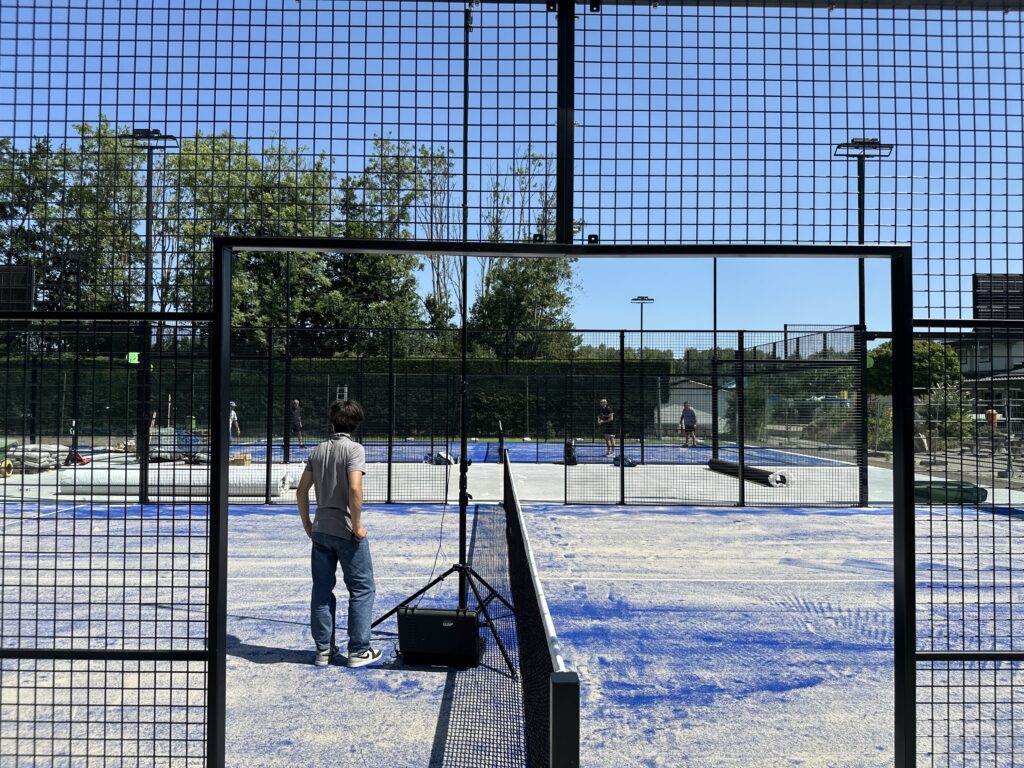
If you want to build a padel court for official use, sooner or later you’ll come across the name Kiwa ISA Sport. This is the body in the Netherlands responsible for the inspection and certification of padel court materials and sports surfaces. Without a valid Kiwa ISA Sport certificate, a padel court may not be used for official KNLTB (Royal Dutch Tennis Federation) competitions. Below we explain exactly what the certification involves, which components are assessed, and how you, as a client, can be sure you’re getting a Kiwa-certified padel court. What is the Kiwa ISA Sport certification for padel courts? The Kiwa ISA Sport certification is an independent product certification for sports surfaces and foundation components of padel courts in the Netherlands. Kiwa ISA Sport assesses whether materials meet the technical requirements of NOC*NSF and the KNLTB. Only products included on the official list of approved sports products may be used for courts intended for competition use. The certification focuses on the sport-technical properties of the court, such as the quality of the artificial turf, the foundation structure, and ball bounce. It is therefore not a general construction inspection, but specifically addresses whether the court meets the standards for fair and responsible play. Kiwa ISA Sport carries out these certifications as a recognized, independent body, separate from manufacturers or builders. Why is the Kiwa ISA Sport certification mandatory in the Netherlands? The Kiwa ISA Sport certification is mandatory because the KNLTB only permits official competitions on courts whose sports surface and foundation have been certified and included on the list of approved sports products. This applies to both new courts and renovated courts as of February 1, 2024. Without a certificate, a court cannot be registered for competition use. The requirement exists to safeguard the quality of play and to prevent courts with substandard materials from being used for official competitions. A padel court with poor ball bounce, insufficient flatness, or an unstable surface has a direct impact on playing quality and player safety. By making certification mandatory, the KNLTB ensures that all courts used for competition meet the same minimum standards. The requirement also protects clients. If a builder supplies materials that haven’t been certified, you, as an association or operator, run the risk that your court will not be approved afterward for official use. That’s a costly mistake you can easily avoid by checking in advance whether all materials are on the list of approved sports products. Which parts of a padel court need to be certified? The Kiwa ISA Sport certification primarily focuses on the sports surface and the foundation structure of a padel court. Specifically, this concerns the artificial turf including the infill material, the foundation on which the turf lies, and the combination of both layers. The steel structure itself falls outside the scope of this specific certification, but must still meet the structural requirements of the Dutch Building Decree (Bouwbesluit). Artificial turf and infill material A padel court uses sand-filled artificial turf: a short-pile, polymeric turf fiber with an effective length of 11 to 15 mm, filled with stabilization material to at least 75% of the fiber length. This applies to both indoor and outdoor courts. The turf is tested for sport-technical properties such as shock absorption, ball bounce, flatness, and friction. Only turf that meets these requirements and is included on the list of approved sports products may be used. Foundation The foundation is assessed as part of the overall system. Foundation components must be certified by Kiwa ISA Sport in the Netherlands before they may be used for a certified padel court. This applies to all commonly used foundation types, such as drainage concrete, Supersub, and ZOAB asphalt (porous asphalt). Each foundation variant has its own technical properties and is assessed separately for suitability for padel. How does the certification process for padel court materials work? The certification process for padel court materials runs through a licensing process at Kiwa ISA Sport. A manufacturer or supplier submits samples of the turf and foundation. These are tested in a laboratory according to international standards, including ISO and EN standards. If a product meets all sport-technical requirements, it is added to the list of approved sports products. Samples of sand-filled artificial turf are conditioned in advance: after filling with infill material, the mat is spread using a rake or brush, so that the test conditions match real-world practice. The measurement methods are laid down in international standards and NOC*NSF measurement methods. For every measurement result, the average must meet the specified requirements, and each individual measurement result must also fall within the standards. As a client, you don’t need to go through this process yourself. Your responsibility is to check whether the materials used by your supplier are already certified and included on the list of approved sports products. Always ask about this explicitly when requesting a quote, and don’t settle for vague assurances. What are the risks of a padel court without Kiwa ISA Sport certification? A padel court without Kiwa ISA Sport certification may not be used for official KNLTB competitions. This means an association or operator can still use the court for recreational purposes, but competitive players may not play official matches on it. For tennis clubs and associations that want their members to take part in competitions, this is a serious problem. Besides the loss of competition opportunities, there are also financial risks. If it turns out afterward that the materials used were not certified, it may be necessary to replace the sports surface or foundation in order to still meet the requirements. Those costs come on top of the investment already made. In the worst case, a newly built court may have to be partially demolished and rebuilt. There is also a safety aspect. The Kiwa ISA Sport standards are not only meant to ensure fair play, but also to protect players. A sports surface that doesn’t meet the shock absorption or friction standards increases the risk